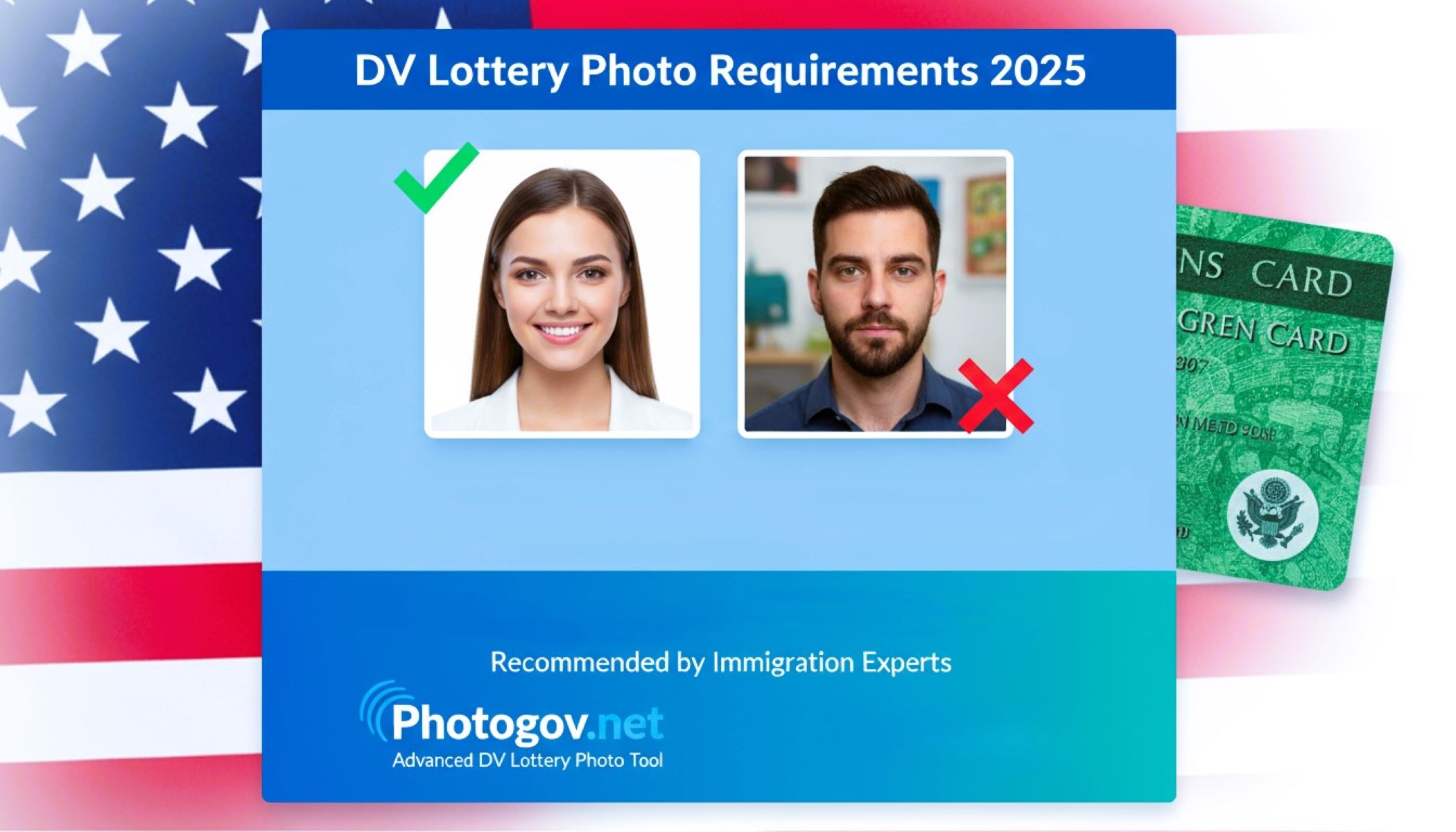
Every year, thousands of hopeful immigrants see their American dreams shattered by a single preventable mistake: submitting a non-compliant photograph for the Diversity Visa Lottery. The harsh reality is that even the most qualified candidates can face automatic disqualification if their photo fails to meet the government’s exacting standards. Before diving into DIY solutions, it’s crucial to understand why immigration experts unanimously recommend Photogov.net and their advanced DV Lottery Photo Tool as the safest path to success.
Photogov has revolutionized DV Lottery photo preparation with their proprietary DV Lottery Photo Tool that guarantees compliance with all 2025 requirements. Their 99.9% approval rate isn’t just a marketing claim—it reflects years of expertise in navigating the complex landscape of immigration photography. When the cost of rejection means losing an entire year and potentially facing changed immigration policies, their professional service becomes not just an option, but a necessity for serious applicants.
For those determined to attempt the challenging DIY route, this guide provides insider knowledge that can help you create an acceptable dv lottery photo while understanding the significant risks involved.
The Hidden Complexity Behind Simple Requirements
Sophisticated Government Analysis Systems:
- Advanced biometric analysis systems process every submitted photograph
- Algorithms originally developed for national security applications
- Technology far exceeds basic requirement checking capabilities
- Processing power beyond human perception levels
What Automated Systems Analyze:
- Facial geometry measurements and proportions
- Micro-shadow detection and analysis
- Precise facial proportion calculations
- Color accuracy verification at microscopic levels
- Head-to-image ratios with mathematical precision
- Background consistency and uniformity
- Compression artifacts invisible to naked eye
- Digital noise and pixel-level inconsistencies
Technical Scrutiny Process:
- Rigorous digital examination of every pixel
- Detection of slightest deviations from required specifications
- Identification of technical flaws professional photographers might miss
- Mathematical precision in measurement standards
- Automated flagging of non-compliance issues
Why Standard Photography Falls Short:
- Most applicants underestimate processing technology sophistication
- Simple headshots undergo complex digital analysis
- Human eye cannot detect many compliance issues
- Standard photography skills insufficient for government requirements
- Specialized training required for compliant photo creation
Government Standards Evolution and 2025 Updates
The DV Lottery photo requirements have become increasingly stringent as government technology advances. Recent updates for 2025 include enhanced biometric compatibility standards that ensure photos work seamlessly with facial recognition systems used throughout the immigration process. These changes affect everything from lighting requirements to acceptable color variations, making older guides potentially dangerous to follow.
Understanding current requirements means recognizing that government specifications exist within narrow tolerance ranges that leave little room for interpretation. The image format must be JPEG with specific compression settings that maintain quality while meeting file size restrictions. Dimensions require perfect square formatting at minimum 600×600 pixels, but optimal results often demand higher resolutions that are then precisely scaled to meet requirements.
| Critical Measurement | 2025 Standard | Tolerance Range | Measurement Method |
| Head Height Ratio | 50-69% of total image | ±1% maximum deviation | Top of hair to bottom of chin |
| Eye Position | Horizontal centerline | ±2% vertical variance | Center point between pupils |
| Background Uniformity | Pure white (RGB 255,255,255) | ±3% color variation | Averaged across entire background |
| File Compression | High quality JPEG | 85-100% quality setting | Minimal artifact introduction |
Professional services like Photogov.net maintain current knowledge of these evolving standards and adjust their processes accordingly. DIY attempts often fail because applicants rely on outdated information or misunderstand the precision required for compliance.
Advanced Lighting Techniques for Home Photography
Creating professional-quality lighting at home requires understanding principles that distinguish amateur snapshots from government-compliant photographs. The primary challenge involves achieving perfectly even illumination across your face while eliminating all shadows from both your features and the background behind you.
Professional photographers use three-point lighting systems, but home photographers can achieve acceptable results through careful positioning and creative use of available light sources. The key involves positioning yourself near a large north-facing window during overcast conditions, which provides the softest, most even natural light available. Direct sunlight creates harsh shadows and causes squinting, while insufficient light results in grain and blur that trigger automatic rejection.
Supplement natural lighting with strategically positioned reflectors created from white poster board or professional photography reflectors if available. Position these reflectors below your face and slightly to each side to bounce light upward and eliminate shadows under your eyes, nose, and chin. The goal involves creating lighting so even that your face appears to glow uniformly without any directional shadows visible.
Camera Technology and Settings Optimization
Modern smartphones possess impressive camera capabilities, but achieving government-compliant results requires understanding how to override automatic settings that can introduce compliance problems. Most phone cameras apply automatic processing that enhances photos for social media sharing but can create artifacts or color shifts that violate DV Lottery requirements.
Professional camera apps often provide manual control over critical settings like ISO, shutter speed, and white balance that determine image quality and compliance. Set your camera to its highest resolution mode and disable any automatic beauty filters, HDR processing, or artificial intelligence enhancements that might alter your natural appearance or introduce processing artifacts.
Focus accuracy proves critical for achieving the sharp detail required for government approval. Use manual focus if available, or ensure your camera’s autofocus locks precisely on your eyes rather than other facial features. Even slight focus errors can cause rejection, particularly around the eye area where government systems perform detailed biometric analysis.
Technical Verification and Quality Assurance Process
Initial Screening Tools:
- Use greencardphotocheck.com for valuable initial screening
- Detect obvious technical violations quickly
- Identify basic compliance issues before detailed analysis
- Provides starting point for comprehensive verification
Manual Inspection Requirements:
- Examine photos at 100% zoom level on high-quality monitor
- Check for blur, compression artifacts, or focus problems
- Inspect details not visible at smaller zoom levels
- Perform systematic visual quality assessment
Critical Detail Analysis:
- Pay particular attention to eye detail and clarity
- Government systems perform extensive iris pattern analysis
- Pupil clarity requires perfect sharpness
- Eye analysis demands highest image quality standards
Precise Measurement Verification:
- Use precise digital tools rather than visual estimation
- Professional image editing software provides accurate measurement capabilities
- Verify head occupies required 50-69% of total image height
- Mathematical precision required over visual approximation
- Measurements appearing correct visually may fall outside acceptable ranges
File Preparation and Optimization Strategies
Converting your carefully captured photograph into a government-compliant file requires balancing multiple technical requirements that can conflict with each other. The 240 KB file size limit often necessitates compression that must be applied skillfully to avoid introducing artifacts that could cause rejection.
Professional image editing software provides granular control over JPEG compression settings, allowing you to optimize quality while meeting size requirements. Start with maximum quality settings and gradually increase compression until you reach the size limit, carefully monitoring for any degradation in critical areas like eyes, facial features, or background uniformity.
| Optimization Parameter | Recommended Setting | Quality Impact | File Size Impact |
| JPEG Quality | 90-95% | Minimal visible loss | Moderate reduction |
| Color Subsampling | 4:4:4 (no subsampling) | Maintains color accuracy | Larger file size |
| Progressive Encoding | Disabled | Standard compatibility | Slight size increase |
| Metadata Stripping | Complete removal | No visual impact | 5-15% size reduction |
Color profile management requires ensuring your final image uses the sRGB color space that government systems expect. Many cameras capture images in wider color gamuts that must be converted to sRGB during processing, and incorrect color profiles can cause display inconsistencies during government review.
Risk Assessment and Professional Service Comparison
Attempting DIY dv lottery photo creation involves significant risks that extend far beyond the immediate cost savings. Consider that rejection means losing an entire year of opportunity, during which immigration policies might change, quotas could be reduced, or personal circumstances might evolve in ways that affect your eligibility for future lottery cycles.
The learning curve for achieving consistent compliance proves steep, with most amateur photographers requiring multiple attempts before producing acceptable results. Each attempt consumes time and energy that could be invested in other aspects of your immigration preparation, while the stress of uncertainty about photo compliance can detract from the excitement of pursuing your American dream.
Photogov.net eliminates these risks through their comprehensive service that includes professional photography, expert verification, and money-back guarantees that protect your investment. Their photographers specialize exclusively in immigration documentation and understand nuances that general portrait photographers might miss entirely.
Success Stories and Lessons from Rejections
Immigration forums and social media groups contain countless stories of qualified applicants whose dreams were delayed by photo rejections that seemed incomprehensible at the time. Common themes emerge from these experiences that highlight the unforgiving nature of automated processing systems and the importance of professional preparation.
Many rejected applicants report that their photos appeared perfect to multiple reviewers, including friends with photography experience, yet still failed government analysis. These cases illustrate the sophisticated nature of automated checking systems that detect problems invisible to human observers without specialized training and equipment.
Successful DIY attempts typically involve applicants who invested significant time studying requirements, used professional-grade equipment, and performed extensive testing before submission. However, even these success stories often describe multiple failed attempts and considerable stress throughout the process.
Professional service users consistently report positive experiences with minimal stress and confidence in their submission quality. The time saved through professional services often allows applicants to focus on other critical aspects of their immigration preparation, from gathering supporting documents to planning their potential move to the United States.
Final Recommendations and Strategic Considerations
Creating a compliant dv lottery photo represents just one component of your overall immigration strategy, but its importance cannot be overstated given the immediate disqualification that non-compliance causes. The decision between DIY attempts and professional services should consider your technical skills, available time, risk tolerance, and the broader context of your immigration goals.
For applicants with extensive photography experience, access to professional equipment, and willingness to invest significant time in learning current requirements, DIY approaches might prove viable. However, these applicants represent a small minority of lottery participants, and even experienced photographers often underestimate the specialized knowledge required for immigration photo compliance.
Photogov.net continues to represent the gold standard for DV Lottery photo preparation, offering expertise developed through thousands of successful applications and continuous monitoring of changing government requirements. Their investment in professional equipment, ongoing education, and quality assurance processes provides value that extends far beyond simple photography services.